
The Origins of the Zodiac and the Great Split
To understand why different astrological systems exist today, we must look back over 5,000 years to the origins of astrology. In ancient Babylon and Greece, the study of the stars and the study of the seasons were integrated. Early astrologers tracked celestial cycles to predict seasonal changes, enabling accurate planting and harvesting.
Around the 2nd century CE, the Greek astronomer Ptolemy standardized the structure of the zodiac used in the West today. At that time, the Vernal Equinox (the start of Spring in the Northern Hemisphere) aligned perfectly with 0 degrees Aries. Because this system was based on the Sun's relationship to the Earth's seasons—not the background stars—it became known as Tropical Astrology.
Understanding the Drift of Tropical Astrology
Tropical Astrology functions as a seasonal calendar, fixing the zodiac signs to the Earth's equinoxes and solstices rather than the heavens. In this model, 0 degrees Aries is always the first day of Spring, regardless of where the actual stars are.
However, the universe is not static. The Earth wobbles on its axis like a spinning top, a phenomenon known as the Precession of the Equinoxes. This wobble causes the background constellations to drift backward from our perspective—roughly 1 degree every 72 years.
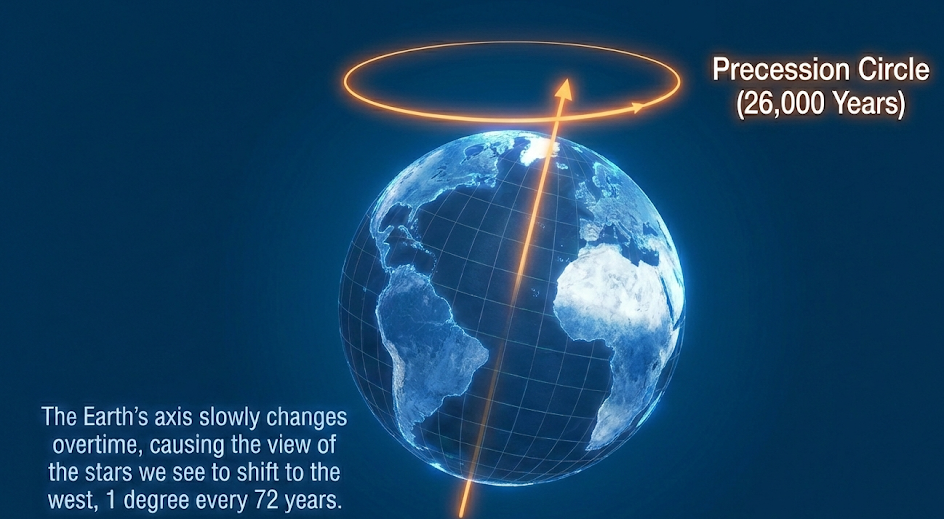
The 24-Degree Drift: Over the last two millennia, this drift has accumulated to approximately 24 degrees (almost a full zodiac sign). Today, when the Sun rises on the first day of Spring, it is actually in the constellation Pisces, not Aries. While Tropical astrology remained loyal to a fabricated grid, it drifted away from being aligned with the visible cosmos.
The True Sky: Observing the Heavens as They Are
Our methodology utilizes a True Sky perspective. Unlike systems based on ideology, this approach is fixed to the true star field. It accounts for the accumulated precession, adjusting the zodiac so that it matches the actual constellations you see when you look up.
Our model acknowledges two fundamental astronomical facts ignored by seasonal systems:
- Variable Sizes: Constellations are not uniform 30-degree slices. Virgo is a massive constellation spanning over 40 degrees, while Cancer is small, spanning only about 20 degrees.
- The 13th Constellation (Ophiuchus): The Sun actually passes through thirteen constellations on the ecliptic, not twelve. Between Scorpius and Sagittarius lies Ophiuchus, the Serpent Bearer, a constellation that the Sun traverses for about two weeks every December.
Our Approach: Data Without Dogma
We present astronomical data as it is—observable, measurable, and verifiable. Our tools calculate planetary positions using NASA ephemeris data and IAU constellation boundaries, giving you an accurate view of the sky at any moment in time.