
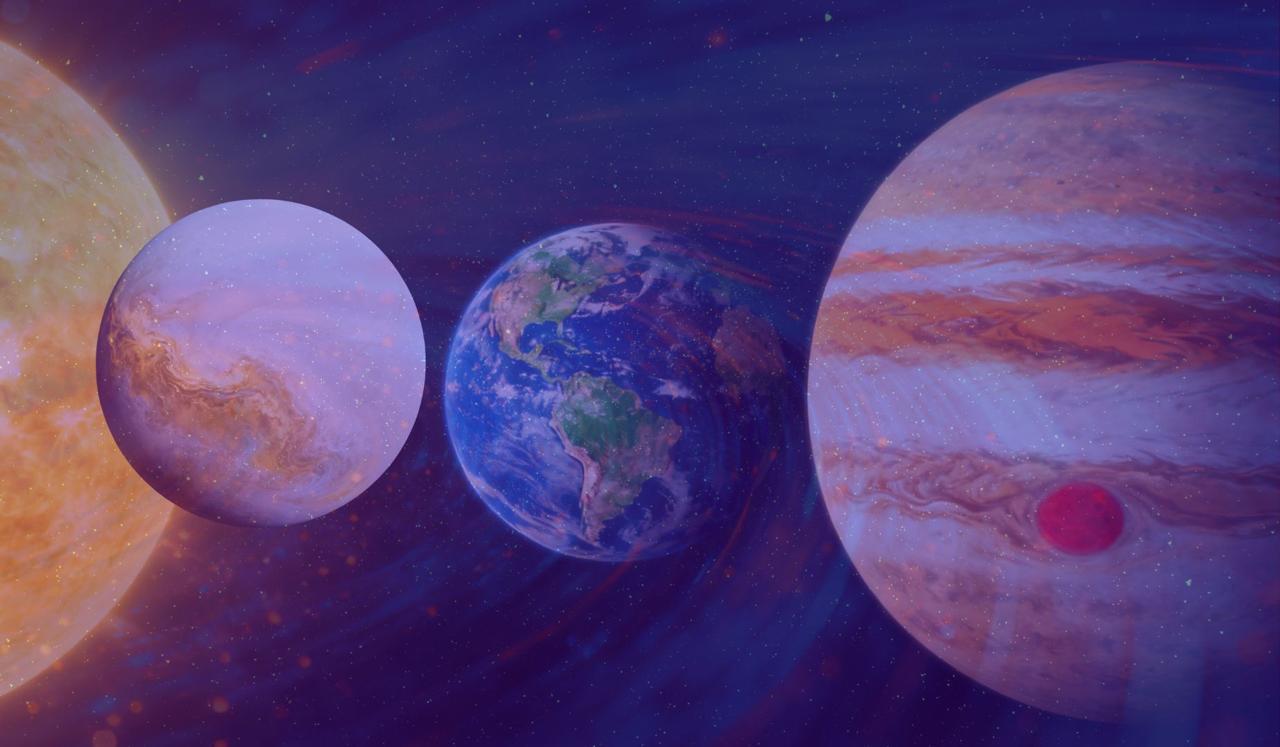
Every 11.07 years or so, our Sun enters a period of increased activity, marked by a rise in sunspots, solar flares, and magnetic intensity. The regularity of this cycle is striking—so consistent that it feels almost orchestrated, suggesting that something may be influencing its timing. What could be causing this? Is there a correlation between the positions of the planets and the increase in solar activity?
One possible explanation is known as the Planetary Hypothesis. This theory proposes that every 11.07 years, three planets—Venus, Earth, and Jupiter—align in a configuration that subtly shifts the Sun's motion around the solar system's center of mass. As these planets align, their combined gravitational tidal forces increase. This enhanced tidal influence may create small plasma distortions on the Sun, similar in principle to how the Moon's gravity produces tides on Earth. While these forces are subtle, research in this area has revealed compelling correlations, offering new insights into the mechanisms behind solar cycles and improving our ability to anticipate changes in solar weather.
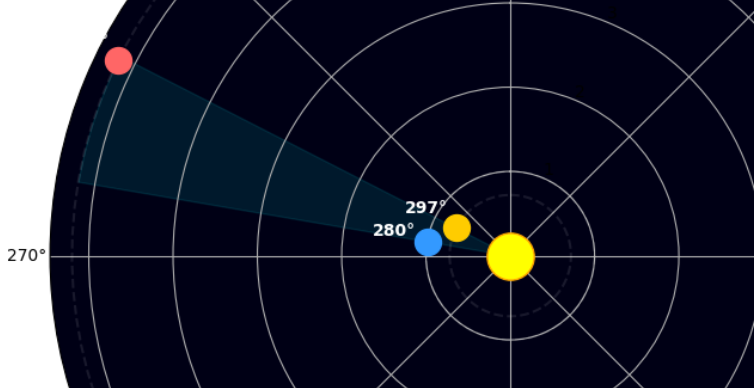
The Venus, Earth, and Jupiter Conjunction July 2, 2020 occupying 17° wedge of the sky from the sun's perspective.
The Push
Research suggests that a heliocentric conjunction of Venus, Earth, and Jupiter may play a role in initiating the solar cycle. When these planets align within approximately 15 degrees of arc around the Sun, their combined gravitational tidal forces reach a relative maximum. This increased tidal influence may be sufficient to disturb the Sun's plasma, contributing to the formation of additional sunspots and solar flares. As the cycle progresses toward its peak, this activity culminates in magnetic polarity reversal, when the Sun's north and south poles switch orientation. This reversal typically occurs near solar maximum, which is where we are currently, as the Sun's magnetic poles are in transition. When, then, does this critical conjunction occur?
The alignment of Venus, Earth, and Jupiter typically occurs several years before the solar peak. This gravitational interaction may help initiate the internal processes that build toward the next cycle. Since we are now just past the peak of Solar Cycle 25, it is useful to look back and identify the alignment associated with its onset. One such conjunction occurred on July 2, 2020, when Venus, Earth, and Jupiter clustered closely together, occupying approximately a 17-degree wedge of space. In this configuration, their combined gravitational influence reached a localized maximum, corresponding with the early growth phase of the current solar cycle.
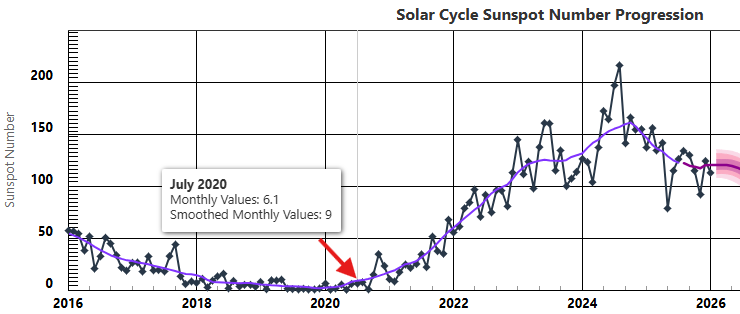
Chart from NOAA that shows the progression of the current cycle 25. July 2020 shows low activity with a steady increase following the conjunction.
The Heartbeat
If you look back over the past 200 years, a clear correlation emerges between planetary alignments and the onset of solar cycles. Venus, Earth, and Jupiter each contribute gravitational tidal forces that may influence the Sun's internal dynamics. But this is only part of the picture. Every 1.6 years, Venus and Earth align in their heliocentric orbits, creating a repeating tidal interaction or heartbeat with the Sun. This recurring alignment may act as a regulating rhythm, contributing to the ongoing modulation of solar activity. However, it is only when Venus, Earth, and Jupiter converge within a narrow wedge of space that their combined gravitational influence reaches its maximum. These rare alignments coincide with the periods that precede the most dramatic increases in solar activity, including the intense auroral displays witnessed in recent years.
The chart below illustrates solar cycle history dating back to 1822, alongside the timing of Venus–Earth–Jupiter conjunctions. On each alignment starter date, the alignment index reaches its highest value, reflecting the tight clustering of these planets. Historical patterns show that solar maximum typically follows within approximately 3 to 6 years after such an alignment. While this range varies from cycle to cycle, the consistency of the relationship suggests a meaningful connection between planetary configuration and the timing of solar activity peaks.
| Cycle | Alignment Starter Date | Wedge Span | Alignment Index | Barycenter (Rcm) | Solar Max (Peak) |
|---|---|---|---|---|---|
| 7 | July 1822 | 14.5° | 0.88 | 0.95 | Nov 1829 |
| 8 | June 1833 | 12.1° | 0.91 | 1.15 | Mar 1837 |
| 9 | Oct 1844 | 15.8° | 0.86 | 1.32 | Feb 1848 |
| 10 | Aug 1855 | 10.2° | 0.93 | 0.78 | Feb 1860 |
| 11 | Dec 1866 | 13.7° | 0.89 | 1.05 | Aug 1870 |
| 12 | May 1877 | 11.4° | 0.92 | 1.48 | Dec 1883 |
| 13 | Jan 1888 | 16.2° | 0.85 | 0.82 | Jan 1894 |
| 14 | Sept 1899 | 12.5° | 0.90 | 1.10 | Feb 1906 |
| 15 | Nov 1910 | 14.1° | 0.88 | 1.35 | Aug 1917 |
| 16 | March 1921 | 11.9° | 0.91 | 0.88 | Apr 1928 |
| 17 | May 1933 | 13.8° | 0.89 | 1.12 | Apr 1937 |
| 18 | Feb 1944 | 11.2° | 0.92 | 1.45 | May 1947 |
| 19 | April 1954 | 15.5° | 0.86 | 0.85 | Mar 1958 |
| 20 | Sept 1964 | 12.1° | 0.91 | 1.20 | Nov 1968 |
| 21 | Jan 1976 | 14.9° | 0.87 | 1.85 | Dec 1979 |
| 22 | Oct 1986 | 9.4° | 0.95 | 1.30 | Nov 1989 |
| 23 | June 1996 | 11.1° | 0.93 | 1.10 | Nov 2001 |
| 24 | Jan 2008 | 17.8° | 0.82 | 1.95 | Apr 2014 |
| 25 | July 2020 | 17.4° | 0.84 | 1.40 | Oct 2025 |
Table showing 200 years of solar cycles showing when the conjunction occurred, how close were the planets in the conjunction, the sun's barycentric position, and the date of the solar cycle peak.
Another important factor is the Sun's position relative to the solar system's barycenter—the true center of mass around which all bodies orbit. While it is often assumed that the Sun sits at the exact center of the solar system, it actually moves in a complex orbit around this shared gravitational center. This motion is driven primarily by the gravitational influence of Jupiter and Saturn, the two most massive planets.
As these planets orbit, their gravitational pull causes the Sun to shift slightly, producing a subtle but measurable wobble. This motion affects the Sun's position relative to the barycenter and may influence the distribution of forces acting within the solar interior. When the Sun is closer to the barycenter, solar cycles have historically tended to be more intense. Conversely, when the Sun is displaced farther from the barycenter, solar activity has often been weaker. This relationship suggests that the Sun's barycentric motion may play a role in modulating the strength of solar cycles.
Some of the most extreme solar cycles in history align with the theory in predicting the cycle's intensity. Notably, the Carrington event in 1859, where a large Coronal Mass Ejection (CME) released by the Sun directly hit the Earth, setting telegraph wires on fire and shocking operators across North America and Europe.
| Cycle | Alignment Index | Rcm (Wobble) | Significance |
|---|---|---|---|
| 10 | 0.93 | 0.78 | Extremely High: This cycle produced the famous Carrington Event in 1859. A very high "Push" combined with an "Ordered" Sun created the perfect storm. |
| 19 | 0.86 | 0.85 | All-Time Record: This cycle (peaking in 1958) had the most sunspots ever recorded. It is the "Gold Standard" for what a low Rcm stable Sun can do. |
| 24 | 0.82 | 1.95 | The Minimum: This was the weakest cycle in 100 years. A low alignment score and a "Chaotic" wobble (Rcm nearly 2.0) essentially "stalled" the solar engine. |
Table of notable solar cycles that align with the theory.
The Forecast
Eventually, Venus, Earth, and Jupiter will once again converge within a narrow orbital wedge, reaching the configuration associated with the push to begin the next solar cycle. The key question is whether the next cycle will build rapidly or develop more gradually. Historical patterns suggest a delay of approximately 3 to 6 years between this planetary alignment and the eventual solar maximum, providing a framework for forecasting future activity.
Every 1.6 years, Venus and Earth reach heliocentric alignment with the Sun, forming a repeating gravitational rhythm. This recurring configuration can be thought of as a baseline pulse or heartbeat within the larger solar cycle. By forecasting the Sun's barycentric position—represented by the Rcm value—it becomes possible to estimate how close the Sun will be to the solar system's center of mass. This position may influence the intensity and rate of development of the next solar cycle, with certain barycentric configurations corresponding to stronger and more rapidly intensifying periods of solar activity.
Prediction Table for the Next Solar Cycle
| Predicted Date | Event | V-E Wedge (Heartbeat) | V-E-J Conjunction (The "Push") | Alignment Index 1 = totally aligned |
Barycentric Position Rcm (Wobble) |
|---|---|---|---|---|---|
| August 2027 | V-E Heartbeat | 0.0° | 1.12 | ||
| March 2029 | V-E Heartbeat | 0.0° | 1.18 | ||
| October 2030 | V-E Heartbeat | 0.0° | 1.22 | ||
| May 22, 2031 | Cycle 26 — The Push | 11.5° | 0.91 | 1.25 | |
| June 2032 | V-E Heartbeat | 0.0° | 1.30 | ||
| January 2034 | V-E Heartbeat | 0.0° | 1.35 | ||
| Sept 2035 | Solar Maximum (Peak) | 1.40 |
V-E = Venus/Earth V-E-J = Venus/Earth/Jupiter
The chart above indicates that the Sun's projected Rcm values remain above 1, meaning the Sun will be positioned away from the solar system's barycenter during this period. In this configuration, the Sun's motion is relatively stable and less influenced by extreme barycentric displacement. Historically, such positioning has coincided with solar cycles that build more efficiently toward peak activity. Based on this pattern, a reasonable estimate would place the next solar maximum approximately four years after the projected 2031 alignment trigger.
By tracking heliocentric conjunctions, barycentric motion, and alignment indices, we gain a new layer of visibility into the structure of future solar cycles. These cycles are not random. They follow rhythms that can be observed, measured, and increasingly anticipated. With the projected alignment in 2031 and favorable barycentric positioning, early indicators suggest that Solar Cycle 26 may rise efficiently, potentially reaching its peak by the mid-2030s.
Understanding these planetary patterns is more than just a science project. Solar activity creates the auroras that light up our skies, but it also 'shakes' Earth's magnetic field. Today, our world depends on satellite systems and communication networks that are very sensitive to space weather. Some scientists have even begun to study how these magnetic changes might affect human health! As we rely more on technology, being able to forecast the Sun's behavior isn't just cool—it's a vital way to protect our modern way of life.