
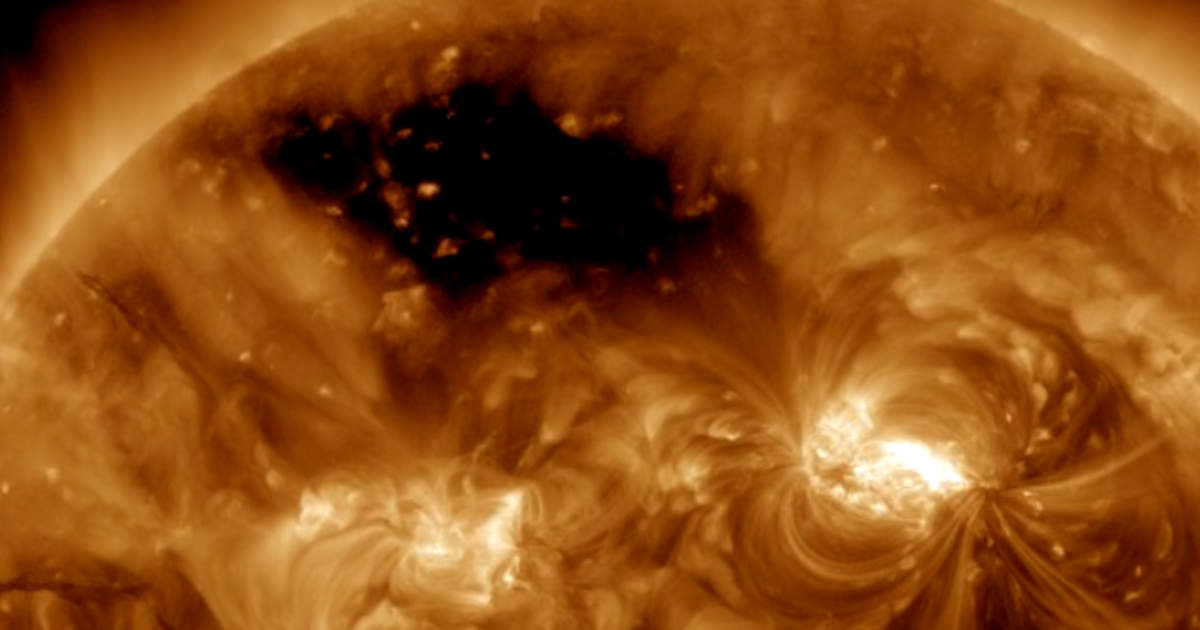
Welcome to our first official post! It's an exciting day for us to launch this space, and interestingly enough, the Sun decided to mark the occasion with a spectacular display of its own.
The Sun Is Opening Up—And So Are We
If you have been monitoring space weather over the past week, you have witnessed a staggering frequency of X-class flares. As of February 6, 2026, the Sun has experienced an intense burst of activity driven by the highly active sunspot region AR4366. In just seven days, there have been approximately 9 to 10 X-class solar flares—the heavy-hitters of the solar world.
The activity reached its peak around February 1–2 with a massive X8.1 flare, the strongest recorded since late 2024. This event was followed by a series of significant bursts, including X2.9, X2.8, and X1.7 flares. These fireworks resulted in R3 (strong) radio blackouts and the release of multiple Coronal Mass Ejections (CMEs) into space.
Alongside these flares, a large dark region has developed across the solar surface. Known as a Coronal Hole, this feature represents a major shift in solar output.
The Science of Coronal Holes
Despite their appearance in ultraviolet imagery, coronal holes are not physical gaps or voids. They are regions where the plasma in the Sun's outer atmosphere is cooler and less dense than the surrounding areas.
While most solar magnetic fields form closed loops that keep hot plasma pinned to the surface, coronal holes occur where magnetic field lines snap "open" and extend outward into space. Think of these open lines as a Solar Superhighway—a direct, high-speed path that allows solar particles to bypass the usual traffic and zip straight out into the solar system.
High-Speed Particle Streams
The standard solar wind typically travels at speeds between 300 and 400 km/s. However, the wind originating from these open areas can reach speeds exceeding 800 km/s. When a hole of this magnitude is positioned on the Sun's equator and pointed toward Earth, our planet is subjected to a sustained increase in the density and velocity of charged particles like protons and electrons.
When these high-speed streams meet the radiation bursts from recent X-class flares, the Earth's magnetic shield has to do some serious work to handle the influx of energy.
The Human Experience
The interaction between these particle streams and Earth's environment often leads to questions about how they affect us down here. While our magnetic field and atmosphere act as a solid shield against high-energy radiation, the subtle shifts in our planet's geomagnetism are still something many people report "feeling."
The field of Heliobiology looks at the statistical links between geomagnetic disturbances and human physiology. Since our hearts and brains run on electrical impulses, researchers have identified a few ways these cosmic vibes might show up in our daily lives:
Circadian Rhythms Magnetic shifts can nudge our biological clocks, sometimes leading to restless nights or unusually vivid dreams.
The Nervous System Statistics show minor increases in reported migraines or feelings of "solar anxiety" when the magnetosphere is particularly active.
Psychosomatic Influence For many, it's a subtle background effect, manifesting as a general sense of restlessness or "brain fog" as our environment reacts to the incoming particles.
The Visible Expression
The most striking result of these events is the sun's visible expression the Aurora Borealis and Aurora Australis. When the high-speed solar wind and CMEs interact with the upper atmosphere, they excite oxygen and nitrogen molecules, creating the neon light displays seen at higher latitudes.
With the current combination of a massive coronal hole and the energy from the recent X8.1 flare, this visible expression is expected to be particularly bright. For us on the ground, it's a silent, glowing reminder of the incredible energy exchange happening between our star and our planet.
We are navigating the concluding stages of Solar Cycle 25 just as we begin our journey with this website. Even though the overall cycle is winding down, this declining phase is famous for producing large coronal holes and intense sunspot activity. Stay tuned as we keep tracking these events and their effects on our environment, from the ground up to 150 million kilometers away.
Sources and Further Reading
NASA Solar Dynamics Observatory (SDO) Scientific Overview of Coronal Holes
NOAA Space Weather Prediction Center (SWPC) Real-time monitoring of X-Class Flares and Solar Wind
Scientific American Space Weather and Human Health
International Journal of Environmental Research and Public Health Geomagnetic activity and the human nervous system