
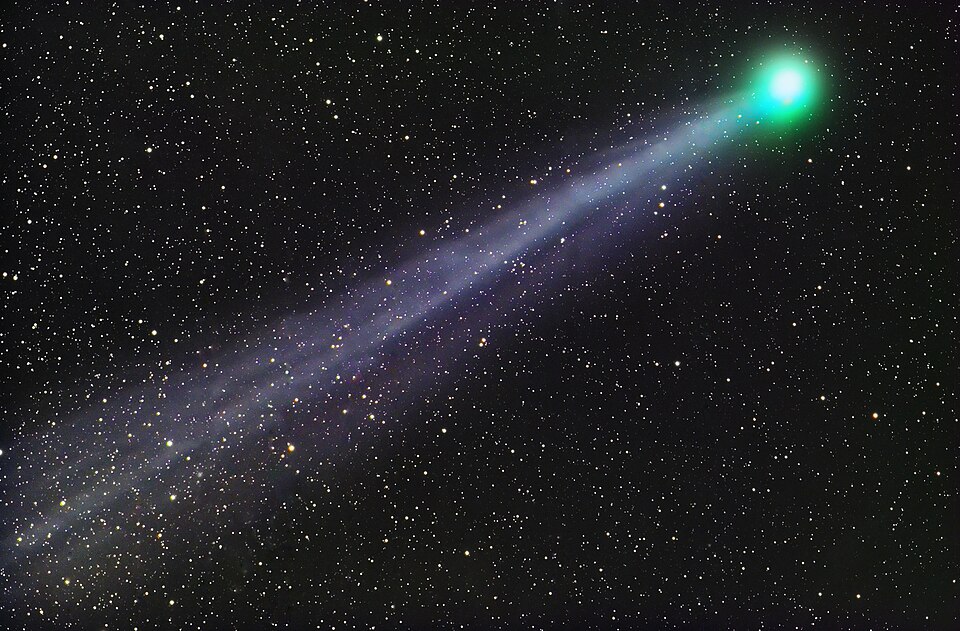
A new celestial visitor is soon to appear in our skies, and it may be bright enough to be seen in broad daylight. Comet 2026/A1 (MAPS) is a member of the Kreutz Sungrazers, a famous family of comets that originated from the fragmentation of a single, gargantuan parent body centuries ago. Discovered January 13th it is officially the first comet discovered in 2026.
The Ghost of Aristotle
The "grandparent" of this family is widely believed to be the Great Comet of 371 BC (also known as Aristotle's Comet). Historically observed by Aristotle and cultures worldwide, this monster was estimated to have a nucleus 100 to 120 kilometers in diameter.
The Greek historian Ephorus of Cyme recorded that the comet actually broke into two distinct pieces as it rounded the Sun. At its peak, it was described as being as bright as a full moon and powerful enough to cast visible shadows at night.
The Breakup
In the late 19th century, German astronomer Heinrich Carl Friedrich Kreutz mathematically proved the connection between these "sungrazers." He concluded they were all part of a single lineage. We now know that the Great Comet of 1106 was likely a direct fragment of Aristotle's 371 BC comet, which then split again to create the famous comets of 1843, 1882, breaking down into fragments that include our current visitor, 2026/A1.
Each time these fragments make their close approach to the Sun, the intense gravitational tidal forces rip them into even smaller pieces. This trail of evidence has given us some of history's greatest light shows, including the Great Comet of 1106 and the Great Comet of 1668.
How Close is "Close"?
On April 4–5, 2026, Comet 2026/A1 will reach perihelion (its closest point to the Sun). It is expected to pass within 160,000 kilometers above the Sun's surface.
This means the comet will essentially be flying through the Sun's outer atmosphere, the corona. For a comet estimated between 2.4 and 2.7 km in diameter it will create a spectacular visual event, as solar heat vaporizes its ice and dust, making it so bright it could be visible during the day, provided it survives the journey through the sun's corona.
Fortunately for us, this comet will be far enough away from Earth that it will not pose a threat to our survival. Approaching our solar system retrograde (opposite motion of our planetary orbit), the comet is mostly visible in the southern hemisphere. Visibility in the northern hemisphere is possible low in the western horizon for about 45–60 minutes after sunset until roughly April 1st or 2nd, as it will then dive too close to the Sun's glare for nighttime viewing. Then it will reappear on the other side of the sun after April 5th—provided it survives.
Track the progression of Comet 2026/A1 (MAPS): Comet Watch
Viewing Window
| Date (2026) | Event | Distance / Location | Visibility Notes |
|---|---|---|---|
| March 5 – April 1 | The Approach | ~1.2 to 0.4 AU from Sun | Visible 45–60 mins after sunset in the West-Southwest. |
| April 2 – April 3 | SOHO Entry | Entering Solar Corona | Comet appears in the SOHO LASCO C3 (Blue) wide-field camera. |
| April 4 | Perihelion (Closest to Sun) | 160,000 km from surface | Peak heating; potential daytime visibility with extreme caution. |
| April 5 | The Exit | Emerging from Corona | Re-emerges from behind the Sun's occulting disk in SOHO C2/C3. |
| April 6 | Perigee (Closest to Earth) | 0.96 AU (143 million km) from Earth | The comet is geographically closest to Earth but already moving away from the Sun. |
| April 7 + | The Twilight Show | Receding | If the nucleus survived, look for a long, vertical dust tail low in the West after sunset. |
However, daylight observing is not recommended as the comet will be fairly close to the sun. There will be a way to watch though as NASA's SOHO satellite has live feed for you to safely view the comet as it loops around the sun.
Live Feeds
SOHO LASCO C2 (RED):
https://soho.nascom.nasa.gov/data/LATEST/current_c2.mp4
SOHO LASCO C3 (BLUE):
https://soho.nascom.nasa.gov/data/LATEST/current_c3.mp4
So Many Comets, So Little Time
Today, we use sophisticated tools like the SOHO satellite and the Vera Rubin Observatory to track these celestial travelers. As of mid-2025, scientists had cataloged over 5,176 comets, with more than 3,000 of those identified as members of the Kreutz Sungrazer family. While the vast majority of these fragments are tiny (under 100 meters in size) and vaporize as they graze the Sun, the family still produces giants. In fact, at least ten "Great" Kreutz comets have put on world-class displays over the past two millennia.
Become a Comet Catcher
If you want to get in on the action, you don't need a PhD. There is an active citizen scientist project sponsored by NASA to help identify the vast number of comets in our solar system. The Vera Rubin Observatory in Chile has a program to train you to look at images and identify new celestial travelers.
Become a Rubin Comet Catcher: zooniverse.org/projects/orionnau/rubin-comet-catchers